

Population growth reshapes landscapes long before it shows up in census numbers. You see it in the fields — farms pushing outward, villages edging closer to wilderness, and the quiet belief that more land must be cleared because more food must be grown.
In the Selous–Niassa corridor, this pressure is already visible. Twenty‑nine villages sit inside one of Africa’s most important ecological pathways, and the landscape is changing fast. Cropland expansion, deforestation, and wildfires have reduced the space where elephants, wild dogs, antelope, and other species once moved freely. As habitats shrink, wildlife enters croplands not out of choice but necessity. The impact on communities is severe. Most households lose crops every year. More than 350 acres of food are destroyed annually, costing over $120,000. For subsistence farmers, this is food security collapsing.
Resentment grows when livelihoods are threatened. Conservation becomes harder to justify, even when its value is understood. For years, farmers have relied on physical guarding, staying awake through the night and confronting elephants with fire or noise. It is dangerous and it drains time from productive work.
A new approach is now emerging.
A project led by Sokoine University of Agriculture, with TAWA and ECOWICE, is introducing an off‑grid, AI‑powered early warning system designed for corridor communities. Seventy‑two solar‑powered cameras will monitor wildlife along 24 transects, connected through a decentralized mesh network. When elephants approach farmland, alerts are sent through an offline mobile app, giving farmers time to respond safely. Solar deterrents help redirect wildlife before conflict occurs.
Fire‑risk and weather alerts strengthen climate resilience.
Indigenous knowledge is integrated.
Women and marginalized groups are trained as Technology Champions.
Expected outcomes include:
• major reductions in human‑wildlife conflict
• fewer crop losses
• stronger economic stability
• improved biodiversity protection
• a scalable model for other African corridors
This is what it looks like when crisis meets innovation. When people who understand both the science and the lived reality design solutions that hold food security and conservation together.
In this landscape, they are the same conversation.
Learn More:
Selous–Niassa Human–Wildlife Conflict Study (2024):
https://lnkd.in/eRK_dbZY
GCBC Climate Resilience & AI Early Warning Project:
https://lnkd.in/eCNssY7n

I’ve been reading through my son’s textbooks, and it’s the same list I remember seeing in mine — repeated in almost every grade, as if the system knew we’d need reminding. Water, air, shelter, community. The fundamentals. The things we were meant to carry into adulthood.
And long before textbooks, many cultures taught these basics naturally — through land, elders, and daily life. No curriculum, just lived truth.
But somewhere along the way, adulthood stretches that simple list. Responsibilities expand. Systems expand. Wants start to behave like needs. The boundary shifts, and we forget what was once so clear.
That shift is how extraction ended up being treated as a “need.”
Mining is now described as a “need,” not a want. A requirement, not a choice. A pillar of modern life rather than a product of the systems we built. And because of that shift, extraction has been allowed to expand into places that were never designed to hold it — including the transfrontier corridors meant to keep Africa’s last great wilderness connected.
Corridors like Selous–Niassa and KAZA were never created to oppose development. They were created to protect the ecological pathways that keep entire landscapes alive. They remain one of the most visionary conservation tools we have.
But they now sit in geographies where human wants have been reframed as human needs.
And that reframing changes everything.
It means extraction and connectivity are no longer separate conversations.
It means wildlife corridors and development corridors now overlap.
It means the question is no longer “Should mining exist?” — because it already does, and we already depend on it.
The real question — the one that matters — is this:
If extraction is a want we’ve turned into a need, how do we protect the things that are truly non‑negotiable: water, air, community, and the living corridors that hold ecosystems together?
This is not a question for activists alone.
It is not a question for extractive industries alone.
It is a shared question — a moral one — for all of us who live in landscapes where human need and ecological need now occupy the same map
Next article: When elephants enter fields and harvests disappear, coexistence becomes survival. A closer look at food, land, and wildlife in corridors
Habitat fragmentation is one of the biggest threats to wildlife today. As landscapes are divided by roads, fences, agriculture, and development, animals lose the ability to move freely — and movement is survival.
Wildlife corridors are the solution. They reconnect what has been broken.
Protected land corridor initiatives are underway in multiple regions, with African case studies providing operational insights into implementation:
The 2025 Addo Elephant Translocation (Eastern Cape)
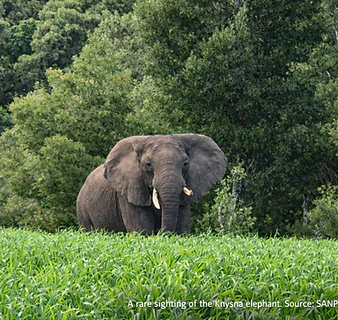
In May 2025, SANParks completed one of the most significant elephant translocations in recent Eastern Cape history — moving 42 elephants from Addo’s Main Camp section into the vast, rugged Kabouga landscape.
This wasn’t just a relocation. It was a strategic intervention to reopen ecological space in a park system fragmented by roads, rail lines, and private land.
The Kabouga section offers:
• Underutilised habitat
• Dense Albany Thicket for browsing
• Mountainous terrain ideal for dispersal
• Space for elephants to re-establish natural ecological roles
This operation is part of a long-term plan to restore historical movement pathways and reduce pressure on over browsed areas — a practical example of corridor-based conservation in action.
🔗 Inside Addo’s Elephant Translocation: https://lnkd.in/dJ4Ti2mn
The Kavango Zambezi Transfrontier Conservation Area (KAZA TFCA): Africa’s Continental Scale Wildlife Corridor System -
The KAZA TFCA spans Angola, Botswana, Namibia, Zambia, and Zimbabwe — forming the largest transboundary conservation landscape on Earth.
KAZA’s mission is to reconnect ancient wildlife migration routes across more than 500,000 km² of linked ecosystems.
It strengthens:
• Elephant migration across borders
• Climate resilience as species shift ranges
• Community livelihoods through nature-based economies
• Landscape level conservation beyond fenced reserves
KAZA TFCA is the clearest demonstration of Africa’s leadership in corridor driven conservation.
🔗 Identifying and Protecting Key Wildlife Corridors in KAZA: https://lnkd.in/dRxveMft (wildcru.org)
🌱 Why Wildlife Corridors Matter:
• They restore genetic diversity
• They reduce human–wildlife conflict
• They protect ancient migration routes
• They rebuild ecosystem function
• They create climate resilient landscapes
From Addo’s hands on elephant management to KAZA’s continental scale connectivity, Africa is not just conserving wildlife — it’s rebuilding ecological systems.

In Kenya’s community‑owned conservancies, land carries identity, ancestry, and the future of entire ecosystems.That’s why legal land documentation isn’t a bureaucratic hurdle —it’s the foundation of ethical development. At Project Kawaakari, we chose the long road — the right road:
-
A formal 30‑year lease with the community
-
Transparent land rights
-
Shared benefit and governance
-
Development that strengthens, not replaces, local heritage
-
A lodge model that uplifts the conservancy and protects wildlife
Because when you build on indigenous land, you’re not just creating a structure —you’re entering a relationship.
Too often, major players have rushed into conservancies without following land laws, bypassing community agreements, and prioritising profit over people. Shortcuts look tempting… until they collapse under legal, ethical, and reputational consequences. Kawaakari is different. We’re building a lodge with the community, not on top of it. We’re creating opportunity without erasing legacy. We’re proving that conservation, culture, and commerce can coexist — when the foundation is lawful, respectful, and transparent. When land rights are honoured, development becomes partnership. When they’re ignored, development becomes exploitation. Kawaakari stands firmly on the right side of that line. Ethical development isn’t just possible — it’s essential.


_jfif.jpg)


